


Fostering Youth-Led Initiatives - Inspiring Moments from the 2026 HLPF Side Event: Humanity at the Center (Part 1)

Updated: Aug 31

The international community faces new challenges and a defining paradox of artificial intelligence and digital technology. Advancing faster than our governance systems can manage, the world needs direct, collaborative, and proactive responses to the use of AI to put humanity at the center
On July 10th, IVECA’s action-oriented High-Level Political Forum Side Event, "Humanity at the Center: Global Citizenship, Ethical AI, and the Water-Energy-Food Nexus for Transformative SDG Action" moved to examine scalable solutions. Organized in partnership with the Permanent Mission of the Republic of Korea the the United Nations and a robust multi-stakeholder partnership, including the Incheon Metropolitan Office of Education’s Incheon East Asia Global Education Institute (IEGI), United Nations Office of Sustainable Development (UNOSD), United Nations Department of Economic and Social Affairs (UNDESA), the Conference of NGOs in Consultative Relationship with the UN (CoNGO), and the Global NGO Executive Committee (GNEC), this event embodied the spirit of SDG 17 (Partnerships for the Goals) by uniting education, technological innovation, and integrated resource governance to safeguard human dignity in a rapidly evolving digital age.
The first part of the event, held at the United Nations Headquarters in New York City, highlighted actionable and glocalized solutions developed by youth leaders around the world. Participating in IVECA virtual global exchange, young innovators from China, South Korea, and the United States presented AI-enabled projects that addressed the key SDGs of this year’s HLPF– water efficiency (SDG 6), clean energy adoption (SDG 7), and urban resilience (SDGs 9 and 11). In their opening remarks, esteemed speakers emphasized the necessity of youth-led initiatives and the significance of their participation in events on the world stage at this critical time.

Mr. Chun Kyoo Park, Head of the United Nations Office for Sustainable Development (UNOSD) opened the event with welcoming remarks, saying that “technology must be guided by human values.” Mr. Park underscored the importance of ethical AI, global citizenship and cross-sector partnerships, while acknowledging AI’s potential to support sustainable systems. Ms. Mi Young Jin, Director of the East Asia Global Education Institute (IEGI), spoke on behalf of Mr. Sunghoon Do, Superintendent of the Incheon Metropolitan City Office of Education, welcoming attendees and student delegations. Ms. Jin noted, “Even small ideas can make a meaningful difference when we cooperate,” setting the tone for the event’s meaningful discussions and impressive work students would present.

Echoing the welcoming remarks. H.E. Ambassador Sangjin Kim, Deputy Permanent Representative of the Republic of Korea to the UN, spoke on the importance of empowering youth as global citizens and active contributors to solving today’s complex challenges. Reflecting on the role of technology, he stressed that innovation must remain guided by shared values and human dignity. “The tools exist, and they are working. Now, what remains open is not whether we use them, but how, by whom, and according to what values."

The keynote speaker, Dr. Kaveh Madani, Director of the UNU-INWEH (Water, Environment and Health), highlighted the event’s focus on the interconnectedness of water, energy, food, health and environmental systems. Dr. Madani called for responsible innovation, data-driven decision-making, and global cooperation to ensure that technological progress benefits both humanity and the planet. He concluded the address with a positive sentiment, “With your help and all of us together, we can make AI and Nexus Thinking our good friend, the friend of humanity, the friend of future generations, and the friend of nature.”

Providing the conceptual foundation of the event, Rev. Dr. Brian K Muzas, Assistant Professor at the School of Diplomacy and International Relations at Seton Hall University, reflected on the 10th anniversary of the Gyeongju Action Plan for Global Citizenship Education. Dr. Muzas stressed that ethical AI must be guided by shared human values. Underscoring that “Our primary identity is human,” he called for renewed commitment to global citizenship education
to ensure technology serves humanity with accountability, equity, and compassion.

These striking opening remarks drove home the importance of the students’ inclusion as future leaders in global discussion and their efforts in developing their projects from abstract theories to actionable plans. Representing their countries, the students were welcomed into the spotlight to share their inspiring work by Dr. Eunhee Jung, President of IVECA International Virtual Schooling.

Students of Shenzhen Middle School (China)
addressed the significant environmental toll of rapid AI expansion. Their project focused on innovative engineering solutions, including a financial roadmap and actions individuals can take to support SDG 7, Clean and Affordable Energy. “Particularly in Shenzhen, the AI economy and infrastructure construction have become primary economic drivers affecting most industries and individuals in the city,” reflecting on both large and small-scale impacts. Student suggested “closed loop liquid cooling systems”, transferring waste heat generated by data centers to local residential houses and equitable, shared public-private investments.

Approaching the same challenge from a different angle, students from Hanil High School (South Korea) also explored transforming AI data centers into circular water–energy–food systems, emphasizing that we all have roles to play in the solutions. Through their exploration of the heavy environmental footprint of AI infrastructure, the team of high schoolers identified the high resource consumption and waste heat generation. Students thoughtfully suggested a digital solidarity fund to support sustainable communities. They emphasized that “we must harness AI for good while simultaneously acting as responsible global citizens,” linking technological innovation with environmental responsibility and the SDGs.

Similarly, the first team of students from IEGI (South Korea) who participated in the IVECA Student-led Global Exchange Academy (iSGEA) this spring, focused on Sustainable Cities and Communities (SDG 11) through their project, Start Young in Jung-gu. Addressing the decline of young people in Incheon's old downtown, they identified a lack of startup information and attractiveness for youth to stay, build their businesses, and contribute to their local community. This primary barrier to youth entrepreneurship inspired their solution: an integrated website that combines startup support resources, an AI-powered consultant chatbot, a policy proposal center, and the youth community. Their project was poignantly summed up: “Today, we choose to believe that every young person deserves the opportunity to build the future they dream of.”

Building on the theme of urban development and the essential role youth play as stakeholders in the future of sustainability, the second team of students from the iSGEA program tackled the challenge of limited green space by redesigning an existing neighborhood park. For the feasibility of their project, the students conducted field visits, community surveys, and expert interviews. Their AI-generated design–reflecting all of their research–aims to replace old-fashioned playground equipment with nature-friendly materials, expand green and ecological spaces, and incorporate AI-powered safety monitoring to create a healthier and more inclusive public space. By combining community input, environmental design, and responsible AI, the project demonstrates how youth can help shape safer, greener, and more livable cities.

Expanding the vision from just more livable to more equitable cities, Ms. Reagin Jones (Seton Hall University, USA) and Mr. Ricky Jang (Georgia Tech, USA) explored how AI, STEAM, and urban agriculture can improve food accessibility in New York. Recognizing that food insecurity is closely tied to transportation, infrastructure, and economic inequality, they proposed an AI-powered planning dashboard to identify neighborhoods where vertical farming investments would have the greatest impact. Rather than creating a new farming model, the project builds on existing initiatives by using data-driven decision-making to guide future expansion. “By combining AI, urban planning, and vertical farming, cities can make more informed decisions about where investments are needed most.”
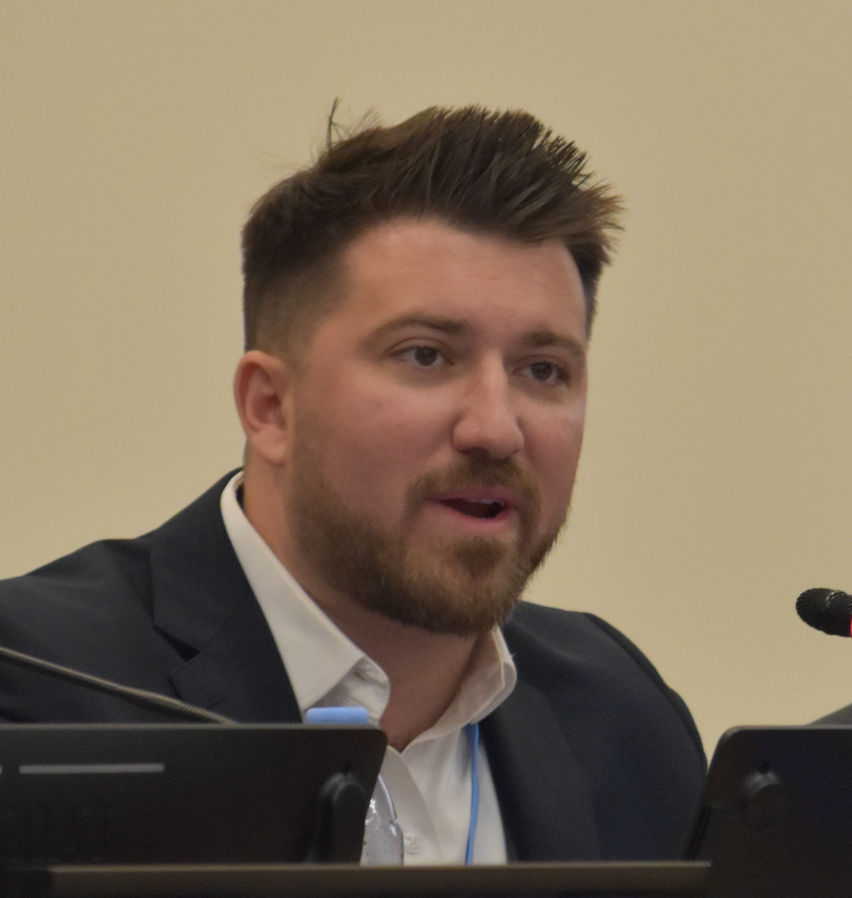
Mr. Noah Zelkind, Chief of Operations at 80 Acre Farms, applauded and echoed the innovation and determination the students presented. Offering a real-world look at how AI has been implemented into essential systems, he shared the reality of scaling vertical farming from concept to one of the world’s largest indoor farming operations. Reflecting on the challenge of developing answers to modern problems, Mr. Zelkind emphasized that “sometimes improving each step is not enough–you have to come up with a new solution that can change the structure of the entire system”.
In his closing remarks, Dr. Peter Preziosi, President of the Conference of NGOs in Consultative Relationship with the United Nations (CoNGO),

praised the event as "awesome" and "inspiring”. He highlighted CoNGO's ongoing efforts to strengthen civil society engagement through the launch of its Civil Society Media Desk and CoNGO Learning Institute, as well as a new report showcasing how NGOs worldwide are advancing the Sustainable Development Goals. Concluding the event, Dr. Preziosi emphasized the importance of collaboration across sectors and generations to accelerate sustainable development and translate innovative ideas into meaningful action.
The first session of the side event demonstrated that addressing today's interconnected global challenges requires more than technological innovation alone. Instead, it demands ethical leadership, global citizenship, and meaningful partnerships across both generations and sectors. By platforming youth innovators, the discussion reinforced that young people are not simply future beneficiaries of sustainable development, but active contributors to shaping it today. The conversation continued at the Permanent Mission of the Republic of Korea to the United Nations, where representatives from across the UN system and other key stakeholders explored how international cooperation, policy, and institutional leadership can help translate these ideas into coordinated global action.
#2026HLPF #AIforHumanity #IVECA #UNOSD. #GlobalCitizenship. #Partnership4SDGs #InterculturalLearning #SDGs
